Structure of regulations
For the process of reg mapping, it is fundamentally important to consider how regulations are structured. There is considerable inconsistency across different jurisdictions and regulators so finding a way to normalise this is critical for the data model and processing. This section explains these inconsistencies in some detail.
US
In the US, regulations are made at Federal, State and local level. Rules or laws made at a local or State level cannot contradict those made at a federal level. Legislative bodies exist at all three levels, plus federal, state and local agencies can also promulgate rules.
For federal regulators such as the Office of the Comptroller of the Currency (OCC), the Federal Reserve, the Commodity Futures Trading Commission (CFTC) and the Securities and Exchanges Commission (SEC), all the regulations are codified in the United States Code, which contains the general and permanent laws of the US. Within the Code of Federal Regulations (CFR), regulations are arranged into Titles which are fairly broad and grouped according to subject matter.
Each title of the Code is subdivided into a combination of smaller units, but different Titles may contain different combinations of Chapters / Subchapters / Parts, making equivalence between different units more difficult to establish.
The units in a Title of the CFR are:
- Subtitles
- Chapters
- Subchapters
- Parts
- Subparts
- Sections
- Subsections
- Paragraphs
- Subparagaphs
- Clauses
- Subclauses
- Items
Other regulators, such as FINRA and the exchanges will structure their regulations in different ways.
Europe
The creation of financial regulation in the EU regulation is standardised, consisting of three levels, known as the Lamfalussy process.
Level 1 - European Parliament and Council adopt laws proposed by
the European Commission. These will either be a Regulation (a binding legislative act which must be applied in its entirety across all Member States) or a Directive (these set out goals that EU countries must achieve but it is as the discretion of Member States how they legislate to accomplish this).
Level 2 - these measures consist of delegated acts or
implementing acts. The former are acts supplementing or amending certain non-essential elements of a basic act. The latter are used where uniform conditions for implementing basic acts are required. Regulatory Technical Standards (adopted via a delegated act) and Implementing Technical Standards (adopted via an implementing act) also fall into this category -- they are written by the European Supervisory Authorities (ESMA, EBA, EIOPS) and Level 1 texts generally include instructions for where RTS or ITS are needed.
Level 3 - European Supervisory Authorities also produce
Guidelines, Recommendations and Questions and Answers which are addressed to national competent authorities and regulated firms but are not legally binding.
EU financial regulations follow the same structure as all legal acts in the EU and consist of the elements shown in Figure 2.4:
Figure 2.4 Structure of EU Legislative Acts
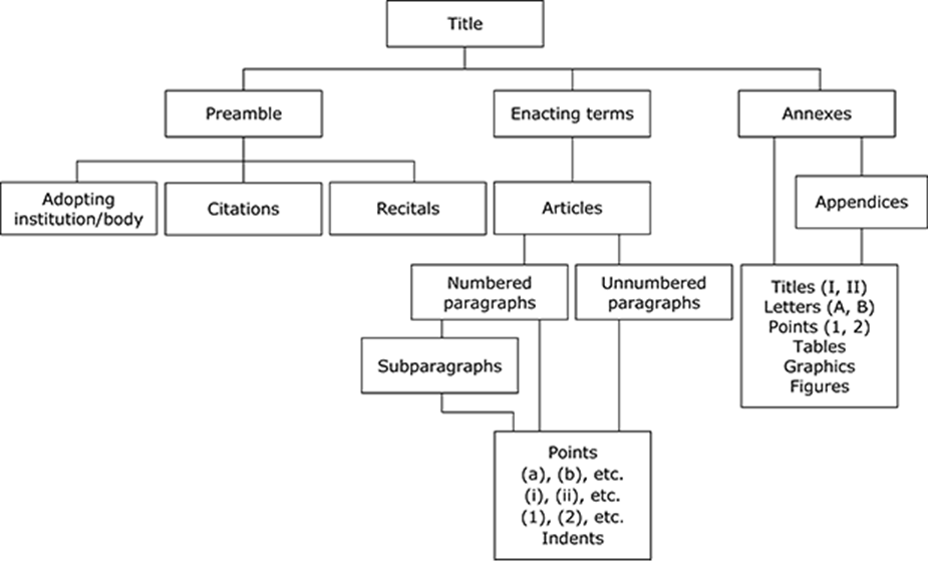
Citations -- include the legal basis for the act and any preparatory acts, as well as the legislative procedure followed.
Recitals -- set out the reasons for the content of the regulation (the elements which actually enact the regulation). Recitals are not legally binding but may be used when interpretation (e.g. by courts) is required where legal provisions are ambiguous.
Articles -- these contain the enacting terms (i.e. the elements of the regulations that must be complied with) and may be grouped in 'parts', 'titles', 'chapters' and 'sections' and further subdivided into paragraphs, subparagaphs, points, indents and sentences. This can vary depending on the text. Please see Appendix 1 - Structure of an EU Act for a diagram of the typical structure.
Annexes -- contain rule or technical data that doesn't appear in the articles, usually in the form of a list or a table. Articles will reference the relevant annexes in their provisions.